Important Changes to Divorce Act

What are the important changes that were made to the Divorce Act in 2021?
- New Parenting Language
- Best Interests of the Child
- Family Violence
- Relocation (Mobility) Rules
- Family Dispute Resolution
- Defined Parties’ Duties
1. New Parenting Language
Which terms have been updated in the Divorce Act?
On March 1, 2021, the Divorce Act has updated parenting terms to better reflect the parent-child relationship.
The term “custody” is replaced with “decision-making responsibility,” emphasizing the right to make significant decisions about the child’s upbringing, such as education and healthcare, without changing the core meaning.
The term “access” has been updated to “parenting time,” focusing on the time a child spends with each parent, regardless of the child’s primary residence.
What kind of orders were added to give non-parents court-ordered time with children?
The term, “contact order” has been added for third parties (non-parent) e.g. non-parents, like grandparents and step-parents who want to obtain legal rights (i.e. an order) to spend time with a child.
2. Best Interests of the Child
The “best interests of the child” is the only consideration for parenting decisions. A judge must consider a detailed list of factors related to the child’s best interests, prioritizing the child’s physical, emotional, and psychological safety, security, and well-being when deciding on parenting time and decision-making responsibility.
3. Family Violence
How was the definition of family violence expanded?
For the first time, under Section 2(1) of the Divorce Act, a definition for “family violence” was added. The definition of family violence has been expanded to include psychological and financial abuse, along with physical and sexual abuse. It now includes witnessing abuse such as seeing a family member being abused. This expansion ensures that the court includes both direct and indirect exposure to violence when making decisions about parenting orders and the capacity of a parent to care for a child. The definition of family violence has been expanded to include psychological and financial abuse, alongside with physical and sexual abuse. It now includes witnessing abuse such as a child seeing a family member being abused.
The new definition is as follows:
“family violence means any conduct, whether or not the conduct constitutes a criminal offence, by a family member towards another family member, that is violent or threatening or that constitutes a pattern of coercive and controlling behaviour or that causes that other family member to fear for their safety or for that of another person – and in the case of a child, the direct or indirect exposure to such conduct – and includes:
(a) physical abuse, including forced confinement but excluding the use of reasonable force to protect themselves or another person.
(b) sexual abuse
(c) threats to kill or cause bodily harm to any person
(d) harassment, including stalking
(e) the failure to provide the necessities of life
(f) psychological abuse
(g) financial abuse
(h) threats to kill or harm an animal or damage property; and
(i) the killing or harming of an animal or the damaging of property“
This change is significant since family violence does not have to be a criminal offence. Nor does it have to be established behind a reasonable doubt.
4. Family Dispute Resolution
How has the Divorce Act been changed to include a definition for the family dispute resolution process?
The Divorce Act, effective March 1, 2021, now includes a definition for the family dispute resolution process (FDR). This process encourages parties in family law disputes to attempt resolving their issues without court intervention, incorporating methods like negotiation, mediation, collaborative law, and arbitration. The Divorce Act mandates individuals to consider FDR where appropriate, with exceptions noted for circumstances involving family violence or significant power imbalances.
What are the three ways the Act encourages the use of a family dispute resolution process?
The Divorce Act encourages family dispute resolution in three specific ways:
- Section 7.3 mandates parties to attempt resolution through such processes;
- Section 7.7(2)(a) requires lawyers to advise their clients towards these non-court methods;
- Section 16.1(6) permits courts to order mediation or similar methods for resolving parenting disputes, aiming to facilitate cooperation and prioritize the child’s best interests.
Under what circumstances is ADR not a viable option to resolve issues?
ADR (Alternative Dispute Resolution) may not be suitable in situations involving a history of family violence, where one party fears the other, or in cases with serious mental health or drug abuse issues.
5. Relocation (mobility) Rules (Move vs Relocation)
Relocation is moving that significantly impacts parenting arrangement. A 60-day written notice with new address and proposed parenting schedule. The other parent has 30 days to respond.
What is the difference between a “move” and a “relocation”?
A “move” refers to a change in residence that doesn’t significantly impact the child’s relationship with anyone who has decision-making responsibility, parenting time, or a contact order. A “relocation” is a move that would significantly affect that relationship, usually due to the distance. Relocations require more formal legal processes and considerations, given their impact on custody, access, and parenting arrangements. When a parent plans to relocate with a child and there’s a court order on parenting, they must notify the other parent at least 60 days ahead using a specific form. If the non-relocating parent disagrees, they have 30 days to object or initiate court action. Relocating without the other parent’s consent or a court order is not permitted.
6. Defined Parental Duties
What new duties have been introduced for parents undergoing separation and/or divorce?
Divorce Act now has explicit duties for parents involved in a divorce.
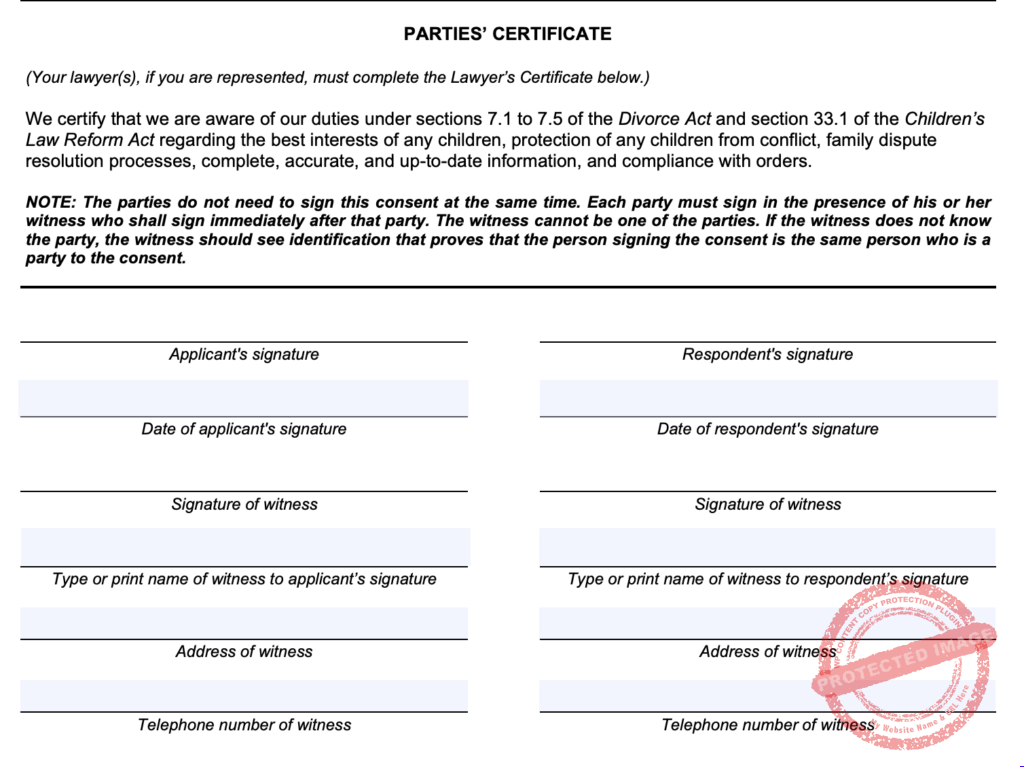
Effective March 1, 2021, sections 7.1-7.5 details parental duties:
- Acting in “best interests of the child”;
- Protecting, to the best of their ability, children from conflict relating to separation/divorce;
- Using, when possible, alternate family dispute resolution (i.e., negotiation, mediation, mediation-arbitration, arbitration).
- Providing complete, accurate and up-to-date information as required, including income, asset and liabilities and information about court orders and proceedings
- Comply with court orders while in effect
In addition, any court document to the start of a proceeding or in response to a proceeding that is filed at court will contain a statement where a party is required to certify that they know about these duties. See Parties’ Certificate below.